
Criminal Cases in the Yoakum County Courts
Yoakum County criminal court cases are divided by offense level. The 121st Judicial District Court has felony jurisdiction. Its Yoakum County files are maintained by the District Clerk at the courthouse in Plains. The constitutional Yoakum County Court hears Class A and Class B misdemeanors because the county has no county court at law. Fine-only Class C charges, traffic citations, and city ordinance cases go to Denver City Municipal Court or the proper Justice of the Peace. That court split makes the alleged offense level a useful first search key.
A booking entry cannot identify the final court result by itself. The Yoakum County arresting officer records an intake charge, but the prosecutor may reject, reduce, amend, or replace it before filing. The clerk's criminal case file shows what was actually filed and how the judge resolved each count. When the only known fact is an arrest, use the Yoakum County arrest history process to find the booking agency and then move to the correct clerk.
Brownfield and Yoakum County Case Files
The 121st District Court serves both Yoakum and Terry counties. Its administrative contact appears in the state directory at 500 West Main, Room 302W, Brownfield, with phone (806) 637-7742. That Brownfield listing can mislead a reader into seeking a Yoakum County criminal file in Terry County. The file remains with the Yoakum County District Clerk at Cowboy Way and Avenue G in Plains. The shared judge travels within the district, but the county of filing still controls the clerk record.
The Texas judiciary's trial-court overview shows why jurisdiction matters before any search begins. Its official explanation also provides useful context for the Yoakum County court structure shown below.
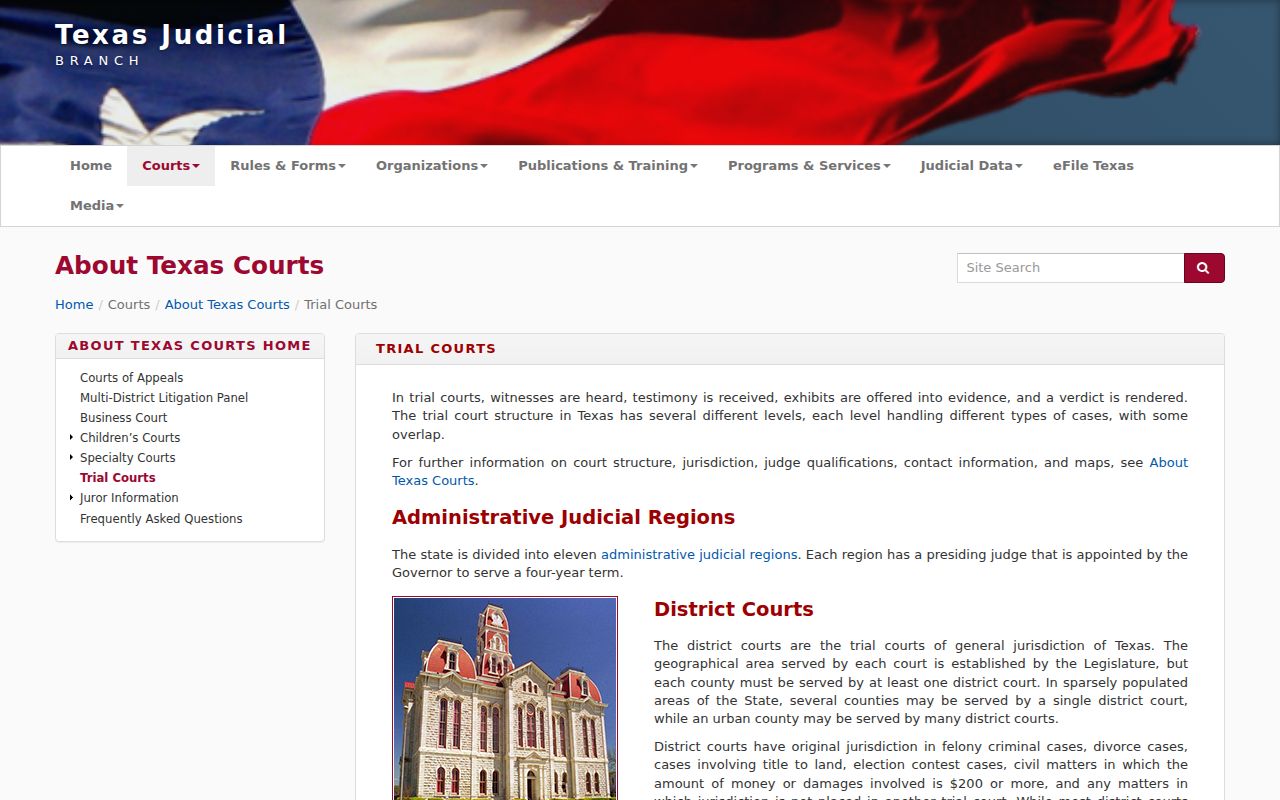
The state overview supports the key Yoakum County rule: use the court and clerk tied to the charge, not merely the district judge's administrative city.
How to Search Case Records
Begin with the full legal name, an approximate filing year, and the cause number if known. For a felony, ask the Yoakum County District Clerk to search the 121st District Court index. For a Class A or B misdemeanor, ask the Yoakum County Clerk at (806) 456-2721, but verify that legacy line before relying on it. A Denver City citation goes to municipal court. A rural fine-only matter should be traced through the court printed on the citation or the correct JP precinct.
The official re:SearchTX platform is a useful supplement. Registration may be required, and court participation or document access can vary. Search results are strongest when the case number is known.
| Search field | Best use | Limit |
|---|---|---|
| Case number | Targets an exact local cause | Format must match the court |
| Party name | Finds cases when no cause is known | Common names can cross counties |
| Court or county | Narrows to Yoakum and the 121st District | Coverage depends on participation |
| Case type | Filters for criminal matters | Older labels may differ |
| Date range | Focuses on an estimated filing period | Not every paper case is indexed |
If the online result is blank, call the Yoakum County clerk for a manual index search. Ask whether inspection is possible at the counter and whether plain or certified copies are available. Published Yoakum County search, copy, and certification rates were not located, so request a current estimate before ordering.
Yoakum County Criminal Court Routing
Similar court names can hide major differences. The constitutional Yoakum County Court is not a county court at law. It handles the county's Class A and B misdemeanor jurisdiction. The District Court handles felonies. Denver City Municipal Court and the two justice precincts handle fine-only matters within their authority. A single name search at one clerk can therefore miss a valid Yoakum County criminal case held at another level.
| Charge level | Court | Record holder |
|---|---|---|
| Felony | 121st District Court | Yoakum District Clerk in Plains |
| Class A or B misdemeanor | Yoakum County Court | Yoakum County Clerk |
| Denver City Class C or ordinance | Denver City Municipal Court | Municipal court clerk |
| Rural fine-only case | Justice Court | Named JP clerk |
Use the filed charge, not the booking shorthand, to confirm routing. If the case moved or was refiled, ask the clerk for each linked cause number.
What the Case File Shows
A Yoakum County criminal case file follows the prosecution after filing. It can show the original charging instrument, later amendments, court settings, motions, pleas, orders, and the final judgment. The Yoakum County docket is a chronological index, while the underlying documents contain the fuller text. Public access to a document can still depend on redaction, sealing, or the platform permissions assigned to the user.
| Case header | Cause number, court, filing date, case type, status, and judge. |
|---|---|
| Filed charge | Offense description, statute, degree or class, count, and alleged offense date. |
| Bond | Amount, type, conditions, and related orders when docketed. |
| Docket events | Charging paper, capias, arraignment, motions, settings, plea, and judgment. |
| Disposition | Dismissal, acquittal, deferred adjudication, conviction, or other recorded result. |
| Sentence | Confinement, credit, community supervision, fines, costs, and restitution when public. |
| Documents | Available pleadings and orders, subject to sealing, privacy rules, and clerk access. |
Social Security numbers, full financial accounts, protected victim or minor data, and other sensitive identifiers should not appear in a public copy. A docket entry may also exist when its attached document is restricted.
Reading Yoakum County Case Outcomes
Outcome terms answer different questions. A Yoakum County dismissal ends a charge without a conviction on that count. An acquittal is a not-guilty finding. Deferred adjudication places a person on supervision after a plea or finding while the court defers final guilt adjudication. A conviction is a judgment of guilt. None of those terms should be inferred from a booking status or from the absence of a name in the DPS public product.
- Disposition
- The current or final outcome assigned to a charge or case.
- Indictment
- A grand jury's formal felony accusation, not a finding of guilt.
- Information
- A prosecutor's formal charging instrument, commonly used for misdemeanors.
- Capias
- A court writ directing arrest, often after charging or a failure to appear.
- Deferred adjudication
- Supervision while final guilt adjudication is deferred under Texas law.
A dismissed Yoakum County criminal case does not vanish automatically. Chapter 55 expunction and a Chapter 411 order of nondisclosure are separate Texas remedies with different rules and effects.
Stages of a Criminal Case
The Yoakum County file grows through a set order, although a dismissal or plea can end the path early. After arrest or summons, a magistrate gives warnings and considers bail. The prosecutor reviews the referral. A complaint, information, or indictment then creates or advances the formal case. Arraignment and pretrial work follow before a plea or trial produces an outcome.
Case flow: Charges Filed → Arraignment → Pretrial → Plea or Trial → Disposition → Sentencing.
Under Texas Code of Criminal Procedure Article 15.17, magistration follows arrest without unnecessary delay and generally within 48 hours. That early event can produce warnings and bond data before the complete clerk file is available. Later motions, amended charges, judgments, or supervision actions can make the court record more accurate than the first arrest-stage account.
When Yoakum Case Search Fails
A blank re:SearchTX result is not proof that no Yoakum County criminal case exists. The court may not expose that filing to the user's role, the case may be older paper or microfilm material, the name may be indexed differently, or the matter may sit in another court. Sealed, expunged, juvenile, and confidential records are also outside ordinary public access.
- Confirm the event county and whether the allegation was felony, misdemeanor, or fine-only.
- Retry with the exact cause number, legal name, and a narrow filing-year range.
- Call the proper Yoakum clerk and ask for a manual index search.
- Ask whether an older volume or archived file needs staff retrieval.
- Request the docket first, then order only the needed plain or certified documents.
The District Clerk and County Clerk work from the courthouse at Cowboy Way and Avenue G, Plains, TX 79355. The county main line is (806) 456-7491, and published county hours are Monday through Friday, 8:00 a.m. to 5:00 p.m.
Access & Restrictions
Clerk-held case records follow the Texas judiciary's access framework rather than the sheriff's incident-report process. The Texas Public Information Act governs public information held by agencies, but an ordinary clerk request is the direct route for a court file. A PIA demand to the sheriff does not make that office the custodian of district pleadings or judgments.
The public Yoakum County case may omit juvenile records, expunged matters, nondisclosed criminal-history information, sealed warrants, protected victim details, driver's-license data, medical information, and financial identifiers. Some files are partly redacted rather than fully closed. The Texas criminal-history dissemination law also makes the DPS product narrower than a clerk file.
The official Texas Government Code Chapter 411 source illustrates those public-access boundaries.
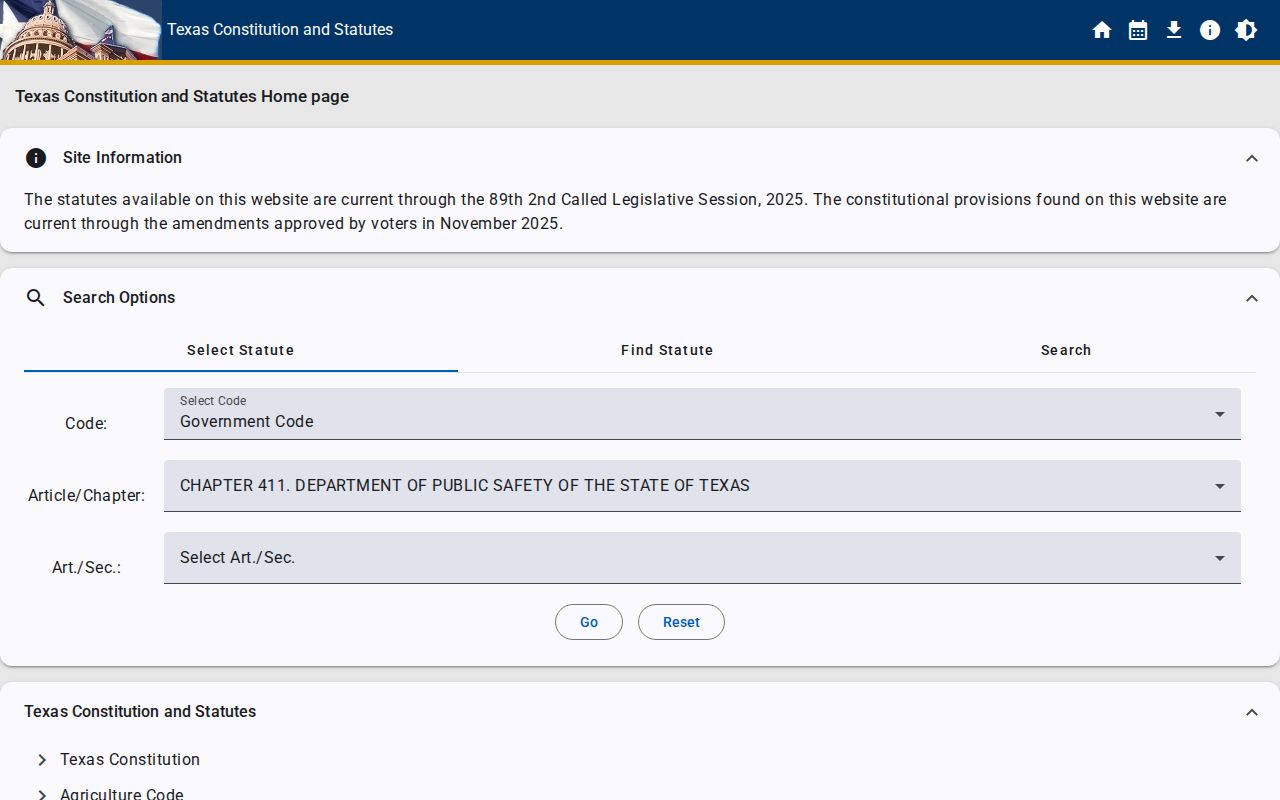
Use a certified clerk disposition when the precise outcome matters, because a statewide name result may lack local pleadings or a recently reported judgment.
Yoakum County Criminal Grand Jury Calendar
Local rules place Yoakum County grand-jury terms in June and December, while the same judicial district uses different months in Terry County. That alternating calendar is another sign that the 121st District Court is shared but its county records remain separate. A returned indictment becomes part of the public court case when filed, while grand-jury deliberations remain secret.
The listed terms do not mean every felony referral waits for one specific month. Yoakum County prosecutors and courts control the course of each case, and settings can change. Ask the Yoakum County District Clerk for the filed cause and current docket instead of predicting status from the calendar. The clerk record, not the calendar alone, shows whether a charge was indicted, dismissed, resolved by plea, tried, or remains pending.
Grand-jury timing also explains why an arrest record and filed felony case may not appear together on the same day. The prosecutor must review the referral, and the grand jury decides whether probable cause supports an indictment. A no-bill means the grand jury declined to indict. A true-bill means it returned an indictment. Neither term should be guessed from a jail entry. The Yoakum District Clerk can confirm whether an indictment was filed and which cause number now controls the court record.